Client Delivery
Part of Task and issue workflows
Preventing abandoned tasks from disappearing in a backlog
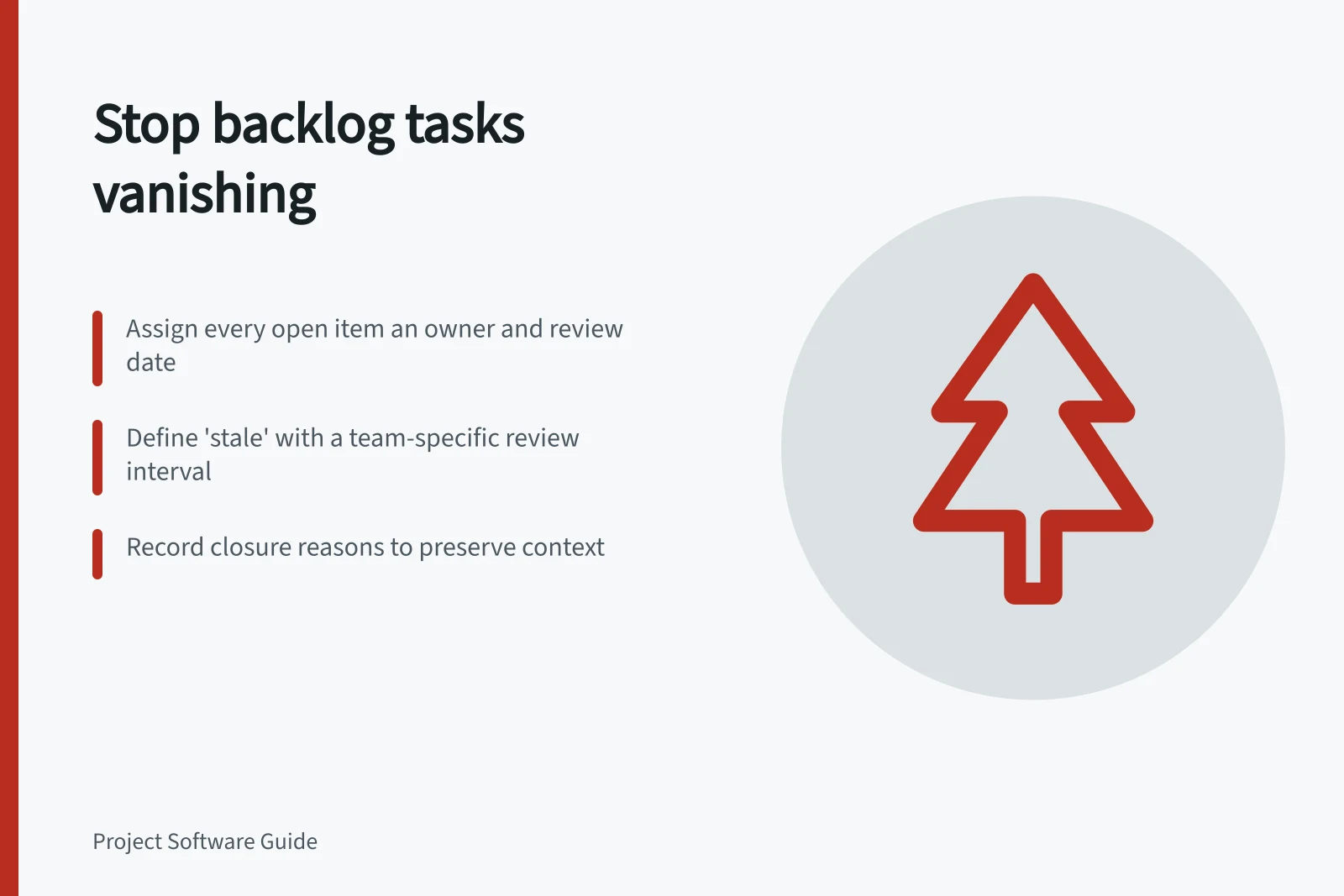
Prevent abandoned tasks by giving every open item an owner, a next review point and a clear closure reason.
Prevent abandoned tasks by giving every open item an owner, a next review point and a clear closure reason. A backlog can hold deferred ideas, but it should not be where requests lose their history. Make a decision about stale work; do not force every old task into active delivery.
Define what “stale” means locally
An item may be old because it is deliberately parked, waiting for a dependency or simply forgotten. Choose a review interval appropriate to the team's pace and distinguish these cases. A task with a named owner and a future trigger differs from an unassigned request with no acceptance criteria. Do not apply one age threshold as a judgement on all work.
Create a short triage view with unassigned items, overdue review dates and work not updated since the last planning cycle. Jira saved searches and backlog views can surface this work. Similar views in other tools should be checked in the team's configuration. A filter has no value unless someone is assigned to review its results.
Make the next action explicit
For each stale item, decide among four outcomes: make it ready for work, request missing information, defer it with a review trigger or close it with a reason. “Keep it just in case” without a trigger recreates the same problem. A deferral note might say, “Revisit when the supplier publishes its revised specification,” rather than a date chosen for appearance's sake.
Ask the requester whether the underlying need still exists when that is practical. A task can become irrelevant because a product changed or another team solved the problem. Closing it is not failure if the reason is recorded and discoverable. If the work returns, the old item provides context for a new or reopened request.
Keep ownership through handoffs
Tasks commonly vanish when their owner changes role or a dependent team takes over. At transfer, record the receiving owner and the action they accepted. A mention in a comment is not the same as accepted responsibility. For a blocked task, identify who is working the blocker and when the original owner will check again.
If a project is paused, label its tasks consistently and record who can restart it. Avoid leaving them in “in progress”, which makes progress reports misleading. A visible paused state or shared reason is useful only if someone maintains it.
Review the backlog as a decision log
During recurring triage, record how many items entered, progressed, were deferred and were closed, but interpret counts cautiously. A reduction caused by mass deletion is not necessarily healthier than a well-explained queue.
Sample a few old items and ask whether a new team member can understand the next action without contacting the former owner. That small test reveals whether the backlog is still a useful plan or merely an archive of unresolved conversations.